
EJ has a degree in fish and wildlife and spent years working for Montana Fish, Wildlife and Parks, which mostly means he is tedious on the subject of binoculars. It also means that when guests ask where to go to see animals, we do not have to think about it. Go to the Lamar.
Why the Lamar and not somewhere closer
The Lamar Valley sits in the northeast corner of Yellowstone. It is a wide, glacier-cut river valley with open grassland on the floor and timber climbing the slopes, and that shape is the entire reason it works. Animals stand out in the open, the road runs along the valley, and you can glass a mile of country from a gravel pullout without walking anywhere. Most of Yellowstone does not offer that. The Lamar does, which is why the serious wildlife people go there and stay all day.
From Pray it means driving south to Gardiner, through the north entrance, up to Mammoth, then turning east. Plan on about 50 minutes each way, plus however long you spend in the park watching, which is usually longer than you meant to. The cabins are open April through October and the tiny homes stay open all winter, so this is a drive you can make from here in any season.
Autumn is the season people underrate
Summer gets the traffic, but fall is when the valley is at its most active, and it is the back half of our cabin season. Elk are in the rut through roughly September and October, and bulls bugle, a thin rising whistle that ends in a grunt and sounds nothing like an animal that size ought to sound. Once you have heard it you will hear it everywhere. Bulls are also unpredictable in this season and worth a wider berth than usual.
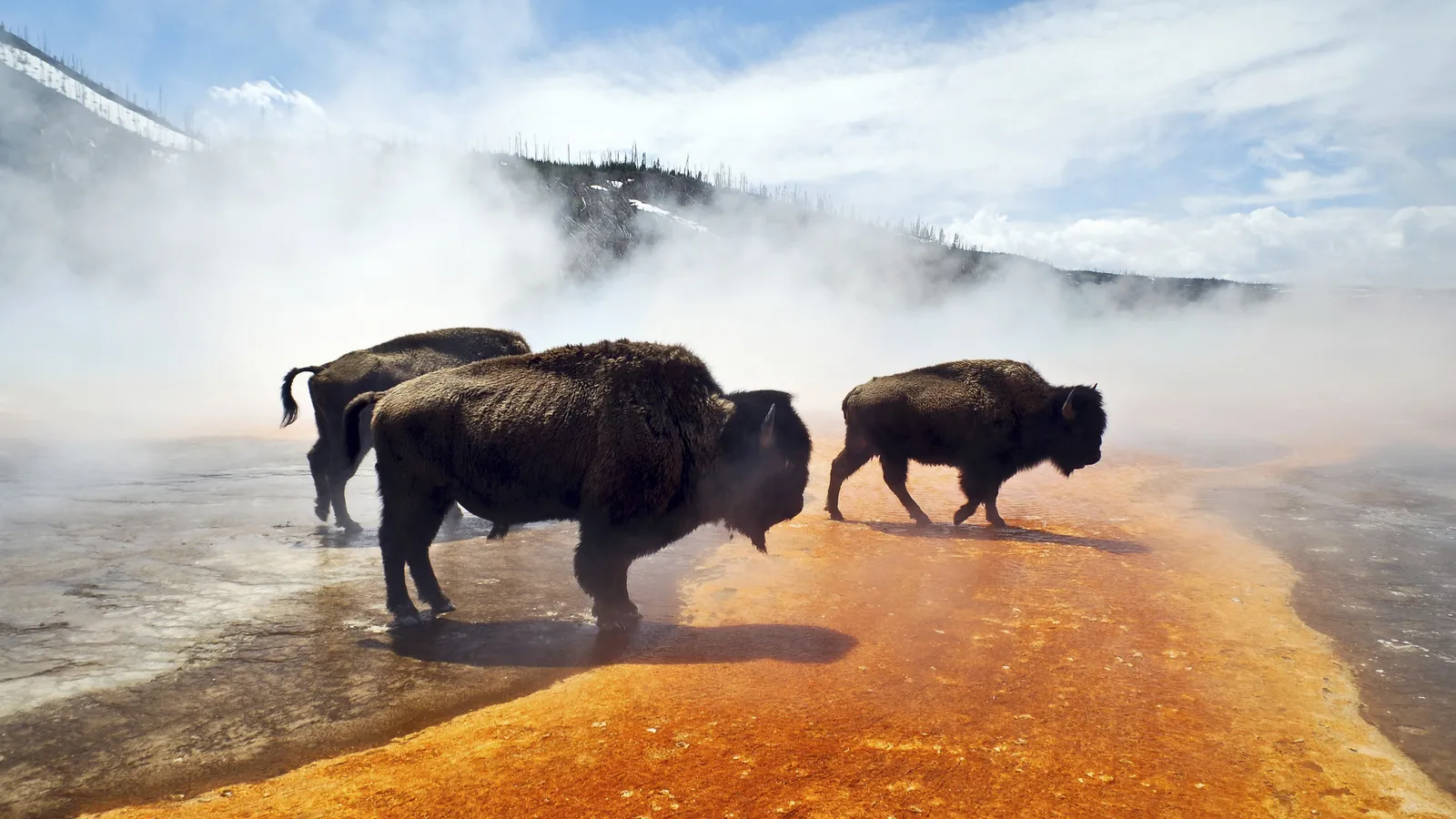
Bison are in the valley year-round and are the animal you are most likely to see, often from your windshield, occasionally in the road. They are not slow and they are not tame. People forget this every single year.
Wolves are the reason a good share of the visitors are there at all. They were reintroduced to Yellowstone in 1995 and the Lamar has been the most reliable place to look for them ever since. We will not pretend to be wolf experts, but the trick is simple: look for the wolf tour guides parked at the pullouts with their spotting scopes. Where they are set up, the wolves usually are too, and in our experience they are generous with a scope and happy to tell you what they are looking at.
How to do it properly
Go at dawn or stay for dusk. The middle of the day is for driving and eating a sandwich. Animals move at the edges of the light, and nearly everyone who reports seeing nothing went at eleven in the morning.
Bring optics. Binoculars are the difference between a brown dot and an animal. A spotting scope is better still, and if you do not own one, the pullout crowd usually will.
Keep your distance. Yellowstone requires at least 25 yards from most wildlife and 100 yards from bears and wolves, and that is a floor rather than a target. Pull completely off the road before you look at anything.
Come dressed for a colder morning than the forecast suggests, and bring your own food and coffee. There is nothing to buy out there. Every one of our stays has a Keurig, a stocked coffee bar and to-go cups, so coffee for the road takes about two minutes on a dark morning.
One note about the dogs
Ours would love the Lamar and are never going. Yellowstone keeps pets close to roads and parking areas and off trails and boardwalks entirely, so a wildlife day is not a dog day. Dogs are welcome here at the cabins, and if yours stays behind for the day, it needs to be well behaved and not a barker. We are hoping to partner with local businesses on a pet-sitting option down the road.
Why we mention any of this
Because you can do the Lamar in a day from here and sleep in the valley rather than inside the park. And because we take one-night stays, which is unusual around here. If the Lamar is the one thing you came for, you are not obliged to book a week to get at it.
Ask us before you go. We would rather tell you what has been moving than have you find out at eleven in the morning.